Weight Management21 August 2026 · 3 min read
Natural approaches to weight management
"Natural" sells a lot of products and explains very little. Here is what genuinely moves the needle — food first, then movement and sleep, always.
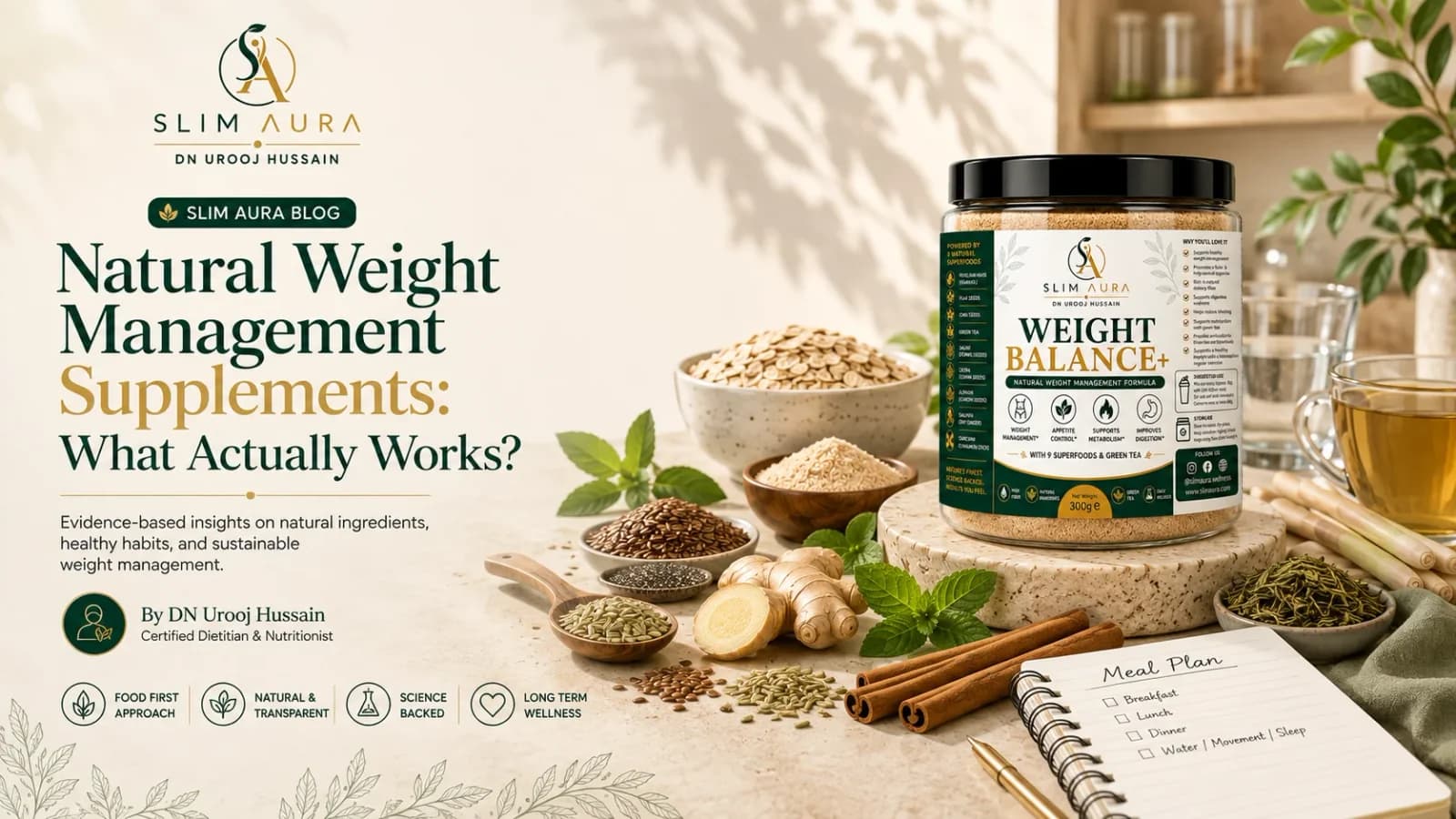
"Natural" is one of the most overused words in this industry, and one of the least useful. It is on everything from a genuinely well-formulated fibre blend to a tea that does nothing but flavour hot water. The word tells you almost nothing about whether something works. What actually matters is what is inside it, in what amount, and what it is being asked to do.
So this is not an argument that natural is automatically better. It is an argument for what I actually see work in practice: food-first changes, done consistently, with natural, transparently-labelled supplements playing a small and clearly defined supporting role — not the leading one.
What "natural" should mean, specifically
When I use the word with a patient, I mean three things: recognisable ingredients you could name yourself, no proprietary blend hiding the actual doses, and a mechanism that is honestly explained rather than implied. Psyllium husk absorbing water and expanding in the stomach is a mechanism. "Detoxifies your system" is not — it is a phrase with no defined meaning, which is usually the point.
Where food-first changes do most of the work
Long before any supplement, three things account for most of the difference I see in practice: enough fibre and protein to stay satisfied between meals, a consistent eating pattern rather than long gaps followed by large meals, and enough sleep to keep appetite hormones behaving normally. None of these are exciting. All three are more powerful than anything sold in a jar.
- Fibre and protein at the meals you actually eat, not a separate "diet meal" nobody keeps up.
- Regular movement — walking counts, and consistency matters more than intensity.
- Seven to eight hours of sleep, which is the most under-rated lever in weight management by a wide margin.
- Enough water, particularly if fibre intake is increasing.
Where a natural supplement genuinely fits
Once the food side of things is moving in the right direction, a fibre-led supplement can help close a specific, common gap: most people simply do not get enough dietary fibre from food alone, and closing that gap supports the fullness and digestive comfort that make everything else easier to sustain.
This is the entire, honest case for a formula like Weight Balance+ — soluble and insoluble fibre from psyllium husk, flax and chia, alongside botanicals traditionally used for digestive comfort, and green tea for its naturally occurring antioxidants. It is designed to sit alongside a food-first routine, not to replace one.
- Check what fibre it actually contains, and how much, per serving.
- Check the ingredient list is short enough to read in one breath.
- Check it makes no claim to work without food, movement or sleep also being in place.
- Give it a full course — weeks, not days — alongside the habits above, and judge the whole routine together.
“A natural supplement is not a shortcut around the fundamentals. At its best, it is one less thing standing between you and keeping them up.”
What is reasonable to expect
Gradual and sustained beats fast and temporary, every time I have watched it play out over years rather than weeks. A fibre supplement will not out-perform a poor diet, and no honest formulation will claim otherwise. What it can reasonably do is support fullness, digestive comfort and consistency — the unglamorous things that, kept up for long enough, are what weight management actually is.
If a product promises results without asking anything of your diet, your movement or your sleep, that promise is the part to be sceptical of — not the natural ingredients underneath it.
This article is provided for general informational purposes and does not constitute medical advice, diagnosis or treatment. Speak to your physician or a qualified practitioner about your own circumstances before making changes, particularly if you are pregnant, nursing, taking medication or managing a medical condition.

Written by
DN Urooj Hussain
Clinical Dietitian & Founder · Doctor of Nutrition (DN)
A clinical dietitian who built the product she kept wishing she could hand her patients.
From the YouTube channel
Fatty Liver Diet & Remedy to cure | Cure Fatty Liver at home | Dn. Urooj Hussain
Serum ferritin |Dietitian UroojHussain|
Benefits of dates(کھجور) |Dieititan UroojHussain|
More writing like this, twice a month
Related articles
12 June 2026 · 4 min read
Weight management: what is reasonable to expect
An honest account of realistic pace, plateaus, and why the number on the scale is a poor daily metric to judge progress by.
Read article
23 August 2026 · 9 min read
Why skipping breakfast isn't the shortcut
Skipping breakfast isn't automatically good or bad for weight management. What matters more is whether the eating pattern you choose actually fits your life.
Read article
14 September 2026 · 4 min read
Choosing a weight loss product that works
Most weight loss products are judged by marketing, not contents. Here is what to check before you buy one — ingredients, dose, and what the label leaves out.
Read article